
The second man to walk on the Moon was a Master Mason. So were the first American to orbit the Earth, the last man to fly a Mercury capsule solo, and a Colorado brother from a lodge in Carbondale. The Craft's connection to the space program is real, frequently exaggerated, and worth getting exactly right.
Buzz Aldrin
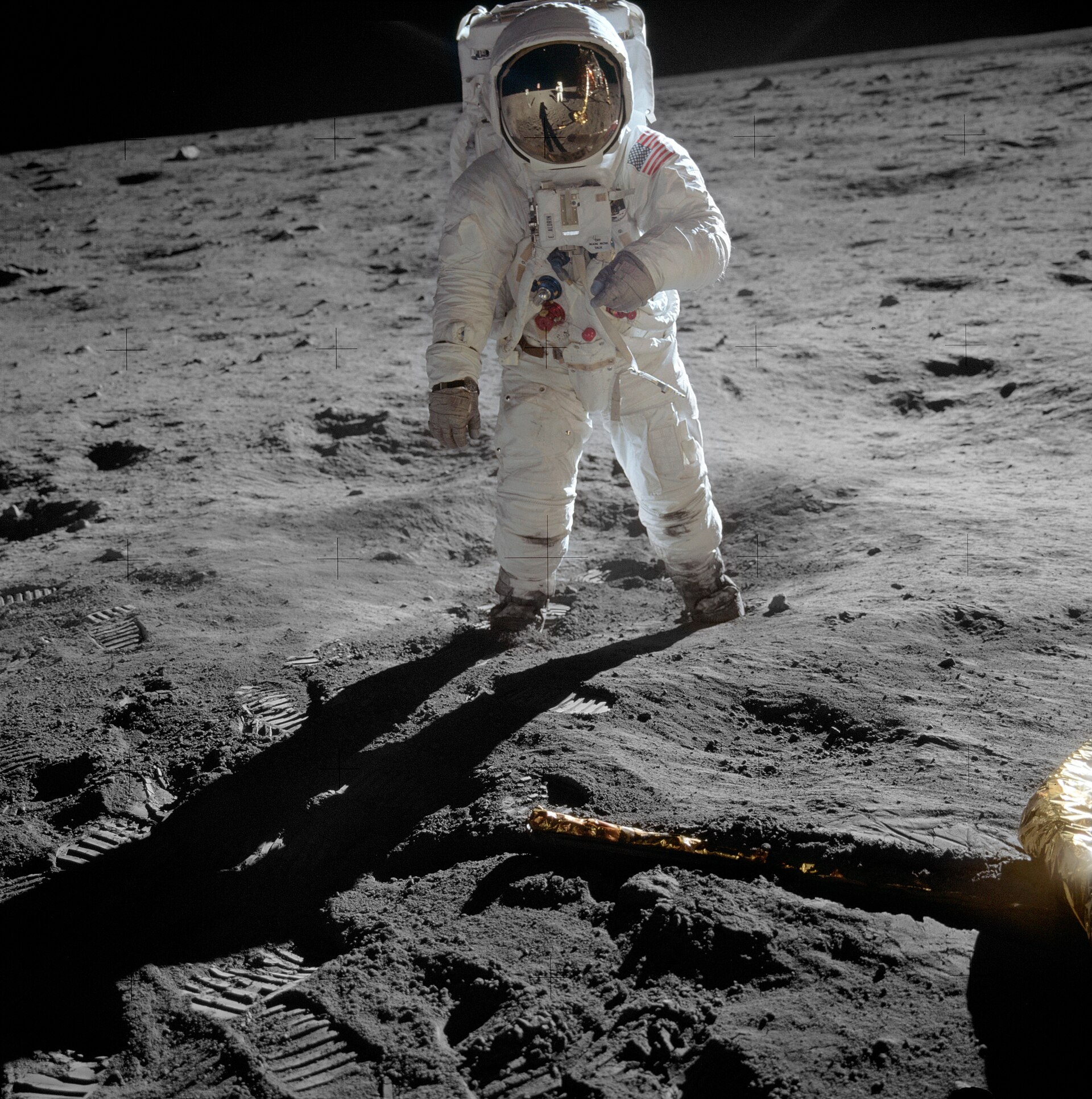
Edwin E. “Buzz” Aldrin Jr. was raised a Master Mason on 21 February 1956 in Montclair Lodge No. 144, New Jersey. He was twenty-six, an Air Force fighter pilot who had flown sixty-six combat missions in Korea, and years away from the doctorate in astronautics that would earn him the nickname Dr. Rendezvous.
On 20 July 1969 he stepped onto the Sea of Tranquility, becoming the first Freemason to stand on another world.
He later affiliated with Clear Lake Lodge No. 1417 in Seabrook, Texas — the lodge nearest the Manned Spacecraft Center — and he is a 33rd degree Scottish Rite Mason. In 1971 the Grand Lodge of New York conferred its highest honor on him.
Aldrin carried Masonic material with him on the flight, and the Grand Lodge of Texas afterward chartered Tranquility Lodge No. 2000, named for the landing site. It has no permanent home; it meets quarterly in different Texas cities, and its stated intention — take it in the spirit it is offered — is one day to hold a meeting on the Moon.
The Others
Aldrin was not alone. A striking share of the early astronaut corps belonged to the Craft, which is less surprising once you remember where those men came from: small-town America, the military, and the engineering schools of the 1940s and 1950s, in a generation for which lodge membership was ordinary.
- John Glenn — first American to orbit the Earth, later a four-term U.S. Senator; an Ohio Mason.
- Virgil “Gus” Grissom — second American in space, of Mitchell Lodge No. 228 in Indiana; killed in the Apollo 1 fire in January 1967.
- Walter “Wally” Schirra — the only man to fly Mercury, Gemini, and Apollo.
- L. Gordon Cooper — flew the last solo Mercury mission and brought his spacecraft down by hand after its systems failed; a Master Mason of Carbondale Lodge No. 82 in Colorado.
- Donn Eisele — Apollo 7, of Luther B. Turner Lodge No. 732, Ohio.
- James Irwin — Apollo 15, who walked on the Moon and later founded a religious foundation.
- Edgar Mitchell — Apollo 14, sixth man on the Moon, of Artesia Lodge No. 29 in New Mexico, and a former DeMolay.
- Thomas Stafford and Paul Weitz also belonged.
Cooper's lodge is the one that ought to interest a Pueblo reader. Carbondale, Colorado — a small town on the Roaring Fork, under Mount Sopris. The man who flew a Mercury capsule by hand and eyeball when its electrical system died was a member of a Colorado lodge not unlike our own.
Two Corrections
Because this is exactly the sort of subject where enthusiasm outruns evidence, two things need saying plainly.
Neil Armstrong was not a Freemason. He is claimed constantly — in books, in lodge newsletters, and all over the internet. He was a member of the Order of DeMolay as a young man in Ohio and is in its hall of fame, and that is very likely the source of the confusion. He never joined a lodge. The first man on the Moon was not a Mason; the second was.
NASA was not a Masonic project. A conspiracy literature exists claiming that the Apollo program was designed and directed by the Craft, complete with numerology about launch dates and lunar coordinates. It is nonsense of the same family as the Pike–Mazzini forgery. What actually happened is unremarkable: several hundred thousand Americans built the program, and among the small group of test pilots chosen to fly it, a normal-for-the-era proportion belonged to lodges.
The true version needs no help. It is quite enough that a member of a New Jersey lodge stood on the Moon.
Why the Fit Is Natural
There is something more than coincidence in it, though it is not what the conspiracists think.
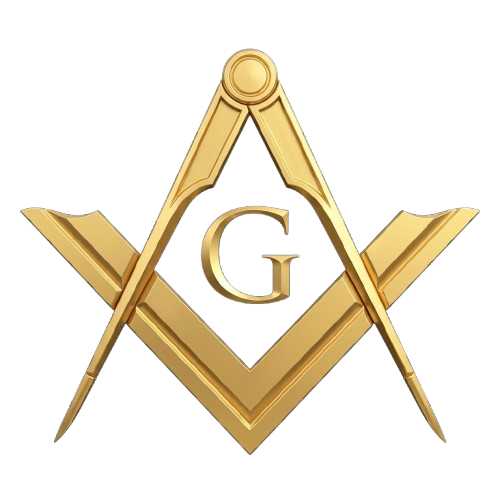
Freemasonry's whole symbolic vocabulary is geometry — the square, the compasses, the letter G, the point within a circle, the forty-seventh problem of Euclid on the Past Master's jewel. The Old Charges treat geometry and masonry as very nearly the same word, and the Regius Manuscript traces the craft to Euclid.
Orbital mechanics is applied geometry. A rendezvous in space is a problem of two curves intersecting at an appointed instant — Aldrin's doctoral thesis was literally on manned orbital rendezvous. The men who solved those problems had spent their working lives on the proposition that the universe answers to measurement.
That is precisely the claim the Craft makes when it hands a man a square and tells him the same discipline applies to his conduct. A lodge asserts that there is an order in things and that a man can align himself to it by taking accurate measurements and acting on them.
It is not surprising that men who staked their lives on that proposition in one domain found it congenial in another.
The View
Aldrin has said that what struck him on the surface was magnificent desolation — a phrase worth a Mason's attention. It holds two things at once: the grandeur, and the emptiness. Both true, neither cancelling the other.
That is roughly the posture the third degree asks a man to take toward his own mortality, and it is a fair description of the sky over southern Colorado on a clear night.
The Moon is up there most nights over the Sangre de Cristos. A Master Mason has walked on it.