Ritual & Education
We confer the three degrees of Masonry — Entered Apprentice, Fellow Craft, and Master Mason — using ceremony preserved across three centuries. Each Brother continues a course of study and proficiency throughout his Masonic life.
About
Freemasonry is the world's oldest and largest fraternity. Silver State No. 95 has been part of it in Pueblo since 1893.
Silver State Lodge No. 95 is a chartered Masonic Lodge under the jurisdiction of the Grand Lodge of Colorado, A.F. & A.M., serving Pueblo and the surrounding region as part of District 26.
Freemasonry is, in its own ancient phrase, "a peculiar system of morality, veiled in allegory and illustrated by symbols." Through ritual, study, and fellowship, we encourage one another to live with greater integrity, charity, and purpose — not in some abstract or future life, but in the practical work of a man's home, his trade, his city, and his country.
Our members come from every walk of life: tradesmen, professionals, veterans, retirees, students. What unites us is the shared belief that a man can always be a better version of himself, and that he is best shaped in the company of others who hold the same conviction.
We are not a religion, nor a service club, nor a debating society — though we honor each. We are a fraternity, and our chief work is the slow, patient improvement of the men inside our walls so that the world outside them may be the better for it.
Freemasonry traces its organizational roots to the operative stonemasons' guilds of medieval Europe and emerged in its modern, "speculative" form in the late 16th and 17th centuries, when lodges began admitting members who were not working stonemasons.
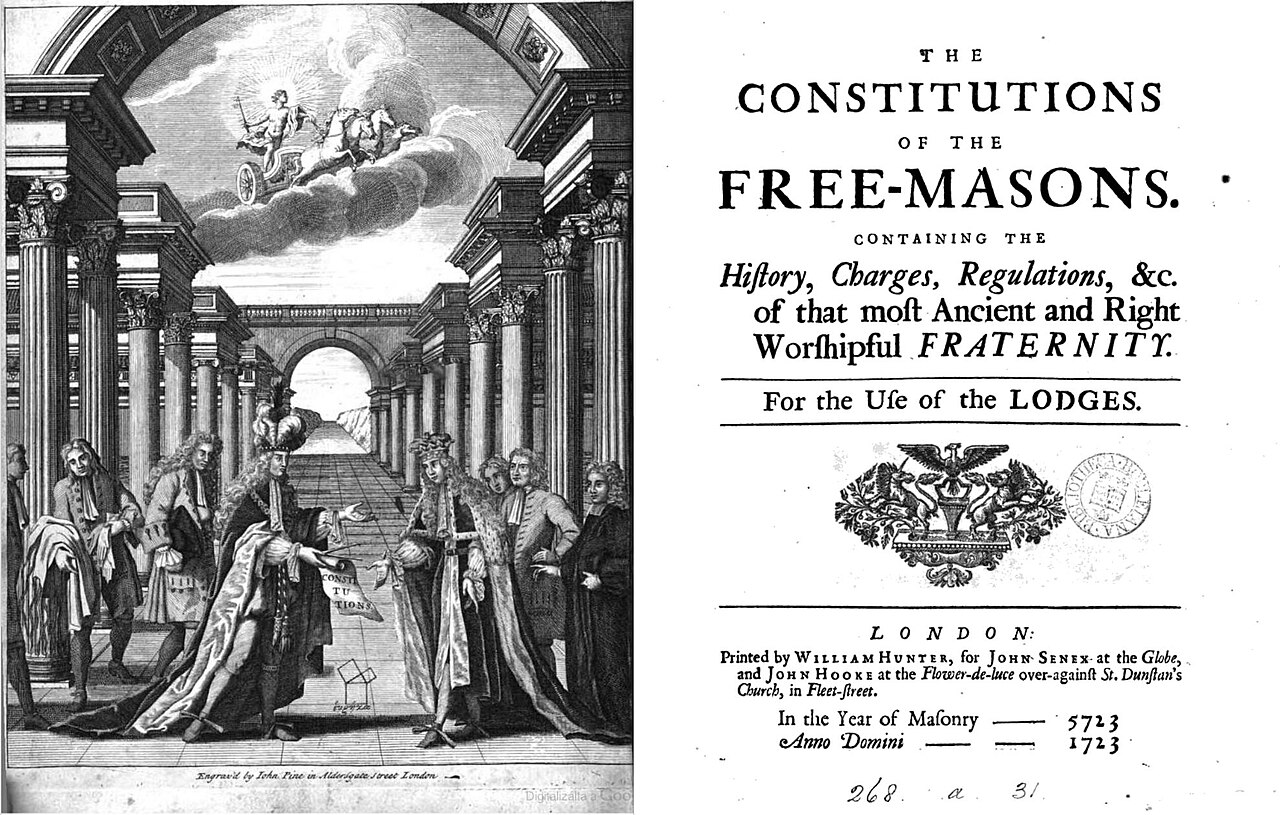
The conventional birth date of organized modern Masonry is St. John the Baptist's Day, 24 June 1717, when four old London lodges met at the Goose and Gridiron Ale-house and elected the first Grand Master of the Premier Grand Lodge of England. Six years later, the Reverend James Anderson published the Constitutions of the Free-Masons — the document that, more than any other, gave the fraternity its modern shape and its enduring commitment to religious tolerance.
The Craft crossed the Atlantic almost immediately. Benjamin Franklin was initiated in Philadelphia in 1731. George Washington took his oath of office as the first President with his hand upon a Bible borrowed from St. John's Lodge No. 1, New York, and laid the cornerstone of the U.S. Capitol in full Masonic regalia in 1793. Of the 56 signers of the Declaration of Independence, at least nine were Freemasons; thirteen of the signers of the Constitution; and fourteen U.S. Presidents.
Freemasonry rode west with the wagon trains. The Grand Lodge of Colorado was constituted in 1861 — fifteen years before statehood — and chartered Silver State Lodge No. 95 on April 12, 1893, in the booming steel-and-silver city of Pueblo.
We confer the three degrees of Masonry — Entered Apprentice, Fellow Craft, and Master Mason — using ceremony preserved across three centuries. Each Brother continues a course of study and proficiency throughout his Masonic life.
Stated communications, festive boards, and the easy fellowship of Monday morning coffee build lifelong friendships across generations and backgrounds. We meet upon the level — equals, all.
From the Christmas & Charity Fund to scholarships for Pueblo seniors and Junior Achievement awards for middle-schoolers, our giving is local, quiet, and consistent.
Every Master Mason has progressed through three degrees of initiation. Each is a self-contained allegory, and each builds upon the one before.
The first degree is an introduction to Masonic light. The candidate is taught the duty of every man to God, his neighbor, and himself. The working tools are the 24-inch gauge and the common gavel.
The second degree is the period of intellectual growth. Its central allegory is the winding staircase to the middle chamber of King Solomon's Temple, with its lessons in geometry and the seven liberal arts. The working tools are the plumb, square, and level.
The third and sublime degree dramatizes the legend of Hiram Abiff. Through it the candidate learns the certainty of immortality and the value of fidelity unto death. The working tool is the trowel — the cement of brotherly love.
No. Masonry is not a religion and does not seek to replace one. We require only that a candidate believe in a Supreme Being; specific faith is a private matter. Men of every creed meet at our altar as Brethren, and the Volume of the Sacred Law is open at every meeting.
No — we are a society with some private traditions among members, but our existence, principles, and good works are entirely public. This very website is a sign of our openness.
Masonry is the only fraternity that does not solicit. A man must ask, of his own free will. Visit our Membership page or write to the Secretary to begin a conversation.
No. "Worshipful" is an Old English honorific meaning "worthy of respect" — the same usage as in "the Worshipful Mayor" of an English town. It is a title of office, not a form of religious worship.