
It began as a lunch club for Masons who thought the fraternity had gotten too solemn. Fifty years later it built a hospital, and then twenty more, and it has been treating children who cannot pay for a century. The Shrine is the least serious thing American Masonry ever invented, and it produced the most serious.
Two Men at the Knickerbocker Cottage
In the early 1870s a group of Master Masons lunched regularly at the Knickerbocker Cottage on Sixth Avenue in New York. Two of them thought there ought to be a Masonic body organized around fellowship and good humor rather than another course of solemn lectures.
Dr. Walter M. Fleming was a physician. William J. Florence was one of the most famous stage actors in the English-speaking world — a comedian who toured Europe and America and played to enormous houses. Florence had encountered an elaborate Arabian-themed entertainment abroad and made notes; Fleming, a capable ritualist, worked those notes into a ceremonial with the help of others, including Charles McClenachan.
On 16 June 1872 the group met to lay the groundwork. On 26 September 1872, thirteen men formally organized Mecca Temple in New York City — the first temple of the Ancient Arabic Order of the Nobles of the Mystic Shrine.
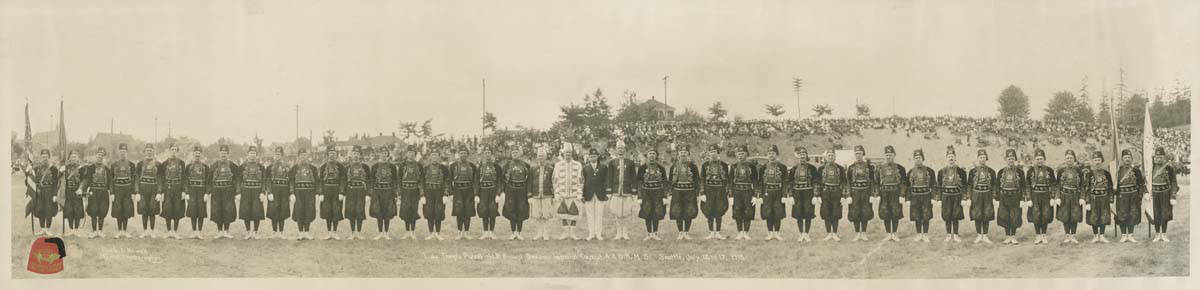
The Near Eastern dressing was theatrical and always was. Florence was a professional entertainer, and the fez, the scimitars, and the vocabulary were costume for a fraternal comedy, not an ethnographic claim. It is fair to say the borrowing reads differently in the twenty-first century than it did in 1872, and reasonable people in the fraternity have said so. It is also fair to record what the costume ended up funding.
It grew explosively. By 1880 there were roughly 7,200 Nobles in 48 temples. By 1900 there were about 55,000 in 82 temples. The Shrine had become the social engine of American Freemasonry — parades, bands, circuses, and a reputation for being the part of the Craft where a man could enjoy himself.
The Decision That Changed It
Then came polio.
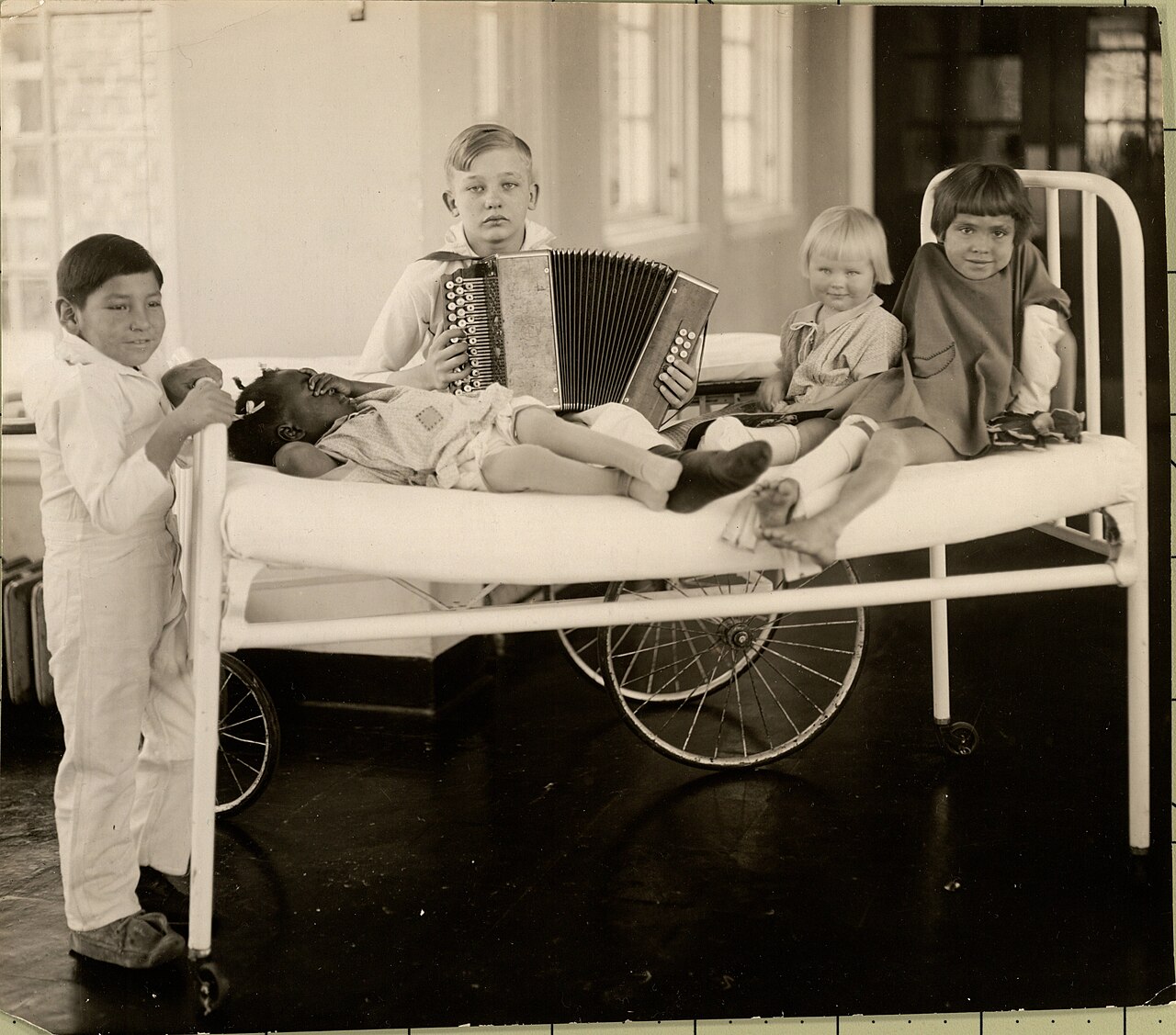
In the first decades of the twentieth century, poliomyelitis was crippling American children by the tens of thousands. Orthopaedic care for them was scarce, and for poor families essentially unobtainable. A child with a paralyzed leg in a mill town or a farm county simply did not get treated.
At its Imperial Council session at the close of the 1910s, the Shrine resolved to do something about it on its own account — not to lobby for it, not to donate to someone else's institution, but to build and run hospitals. The Nobles voted to assess themselves to pay for it, a fixed sum per member per year.
The first Shriners Hospital opened in Shreveport, Louisiana, on 16 September 1922. Others followed quickly, and within a few decades there were more than twenty across North America.
A Century of Changing With the Illness
What makes the system genuinely impressive is that it did not calcify around its founding purpose.
Polio was largely defeated by the vaccines of the 1950s. Rather than declare victory and wind down, the hospitals turned to the pediatric conditions that remained hardest and least profitable to treat:
- Pediatric orthopaedics broadly — scoliosis, clubfoot, limb differences, cerebral palsy, brittle bone disease.
- Burns. In the mid-1960s the Shrine opened facilities established specifically for the acute and rehabilitative treatment of burned children — the first of their kind anywhere, at a time when severe pediatric burns were very often fatal. Survival rates for major pediatric burns transformed over the following decades, and Shriners burn centers were central to that.
- Spinal cord injury. In the early 1980s the system launched the country's first pediatric spinal cord injury rehabilitation programs.
- Cleft lip and palate, and a broad range of complex reconstructive work.
In 2021 the system took the name Shriners Children's, reflecting a network that now reaches well beyond inpatient hospitals into outpatient clinics, telehealth, and research, across the United States, Canada, and Mexico.
The Rule That Has Never Changed
One thing has held for a hundred years: a child is treated regardless of the family's ability to pay or insurance status.
The mechanics have modernized — the system bills insurance where insurance exists, because refusing to do so would simply burn donated money that could treat another child. But the operating principle is intact: no family is turned away because they cannot pay, and no family is pursued for what they cannot pay.
Behind that sits the endowment and the annual giving of the Nobles, built up assessment by assessment since the 1920s.
Who Can Join, and What It Means Here
For most of its history the Shrine required a Master Mason to have gone further — the Scottish Rite's 32nd degree or the Knights Templar — before petitioning. That requirement was dropped in 2000. Today any Master Mason in good standing may petition a Shrine temple.
The relationship runs the right way round, and it is worth being clear about it: the Shrine is not a higher body than the lodge. It is an appendant body that draws its entire membership from Master Masons. A man's lodge is where he is made; the Shrine is one of the places he may afterward choose to labor.
Colorado Nobles support the system, and Colorado families use it. For a Pueblo family with a child facing scoliosis surgery, a serious burn, or a limb difference, the practical fact is simple: there is a place to go, the care is first-rate, and the bill will not destroy them.
That is what a hundred and fifty years of parades, fezzes, and cheerful nonsense turned out to be for.