
The single hardest question in Masonic history is not where the ritual came from. It is how a trade union of stonecutters turned into a moral society of gentlemen who never touched a chisel — and why the stonecutters let it happen.
Two Words, Precisely Defined
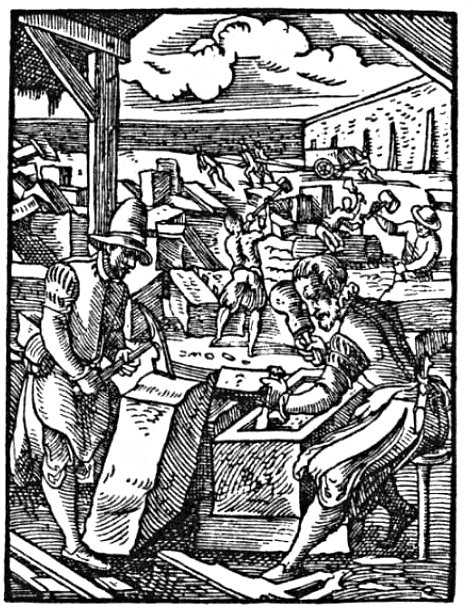
An operative mason cut and set stone for wages. His lodge was a shed on a building site, his secrets were trade secrets, and his rules governed apprenticeships, wages, and workmanship.
A speculative mason uses the same tools as symbols. The square teaches him to square his actions; the plumb, uprightness; the level, equality. He builds nothing but himself.
Every Mason knows this distinction because the ritual states it. What the ritual does not explain is the transition — and the transition is the whole mystery.
Scotland's Century
The best evidence for how it happened comes from Scotland, because Scotland kept minutes. When William Schaw ordered lodges to record their proceedings in 1598, he unintentionally created the archive that lets us watch the change occur.
The historian David Stevenson made the case in The Origins of Freemasonry: Scotland's Century, 1590–1710, and it has reshaped serious scholarship since. His argument, briefly: the essential features of modern Freemasonry — permanent lodges with elected officers, written records, initiation ceremonies, secret modes of recognition, and a body of legend and symbol attached to the craft — came together in Scotland around 1600, among working stonemasons, before any of it reached England.
Then the record shows the composition of those lodges changing.
- 1600 — John Boswell, Laird of Auchinleck, attests a minute of the Lodge of Edinburgh with his mark. He is a gentleman, not a mason, though what exactly he was doing there is genuinely unclear.
- 1634 — the same lodge records the admission of non-operative members. This is the first unambiguous instance in the record.
- Through the rest of the century the Scottish lodges accumulate gentlemen masons, and the vocabulary shifts to distinguish them from the working domatic members.
- 1646 — across the border, Elias Ashmole is made a Mason at Warrington in a lodge that appears already to be substantially non-operative.
Stevenson notes an important asymmetry: in Scotland, nearly all lodges before 1710 remained tied to the actual stone trade, gentlemen or no. In England the pattern ran the other way — lodges were increasingly gentlemen's creations from early on. Two different roads to the same destination.
The Question Nobody Can Fully Answer
Why would a working trade lodge admit men who could not work?
Several explanations are offered, and the truth is probably some combination of them.
Patronage. A lodge with a laird or a merchant among its members had a friend when it needed one — in a dispute, before a magistrate, or in the matter of who got the next contract. This is unromantic and almost certainly part of it.
Decline of the trade lodge's original purpose. As the great cathedral-building era receded and the building trades were reorganized, the lodge's function as a labor institution weakened. An organization losing its original job will often find a new one.
Intellectual fashion. This is the part that is easy to underrate. The seventeenth century was fascinated by geometry, architecture, sacred proportion, hermetic philosophy, and the art of memory — and here was an ancient society that claimed descent from Euclid, possessed a legend about Solomon's Temple, guarded secrets, and required its members to be tried in the art of memory. To a Renaissance gentleman with antiquarian tastes, a mason's lodge looked like exactly the sort of thing worth getting into. Elias Ashmole is the type specimen.
A place to meet. In a century of civil war, religious persecution, and shifting regimes, a private society with a rule against religious and political quarrels was genuinely useful. Ashmole's Warrington lodge, receiving a Royalist and a Parliamentarian together in 1646, is the evidence.
What Was Kept
The most striking thing about the transition is how much of the operative craft survived it — not as decoration, but as structure.
The Old Charges passed straight through: the Regius Manuscript's rules on keeping counsel, relieving a brother, settling quarrels internally, and dealing honestly are recognizably the obligations of a modern Mason. The officers Schaw defined are still the officers. The progression from apprentice to fellow craft, with an examination between, is still the progression. The tools remained the tools — and this is the crucial point: the gentlemen did not replace the mason's kit with a philosopher's. They kept the gavel, the chisel, the square, the level, the plumb, the trowel, and re-read them.
That choice is why Freemasonry is not simply another eighteenth-century gentlemen's club. Its entire moral vocabulary is borrowed from manual labor. A Mason is not told to contemplate an abstraction; he is handed the tools of a working trade and told what they mean about his conduct. The dignity of skilled work is built into the system at the root, because the system was designed by men who did skilled work.
The Honest Limits
Three cautions, because this is the area of Masonic history where speculation runs hardest.
There is no single moment. No lodge voted to become speculative. The change took roughly a century and looked different in every town.
The Templar, Egyptian, Rosicrucian, and Essene origin stories are not supported. Every one of them was composed in the eighteenth century or later, and each can be traced to identifiable authors. The documented line runs through medieval stonemasons' guilds, the Old Charges, and the Scottish lodges — and it is a more interesting line than the invented ones.
The record is thin and accidental. We know what a handful of Scottish lodges wrote down and what one English diarist happened to note. Whole regions are silent. Anyone who tells you exactly how it happened is telling you more than the evidence supports.
Why It Matters at a Stated Communication
Because it explains what a Mason is doing.
The lodge did not begin as a debating society that adopted building metaphors for color. It began as actual builders who had actual rules about honesty, confidence, mutual aid, and quality of work — rules they needed in order to survive on scaffolding, far from home, dependent on one another.
When gentlemen joined, they did not invent a morality. They inherited one from working men, and agreed to be bound by it.
That is worth remembering in Pueblo, a steel town, in a lodge chartered in 1893 by men who worked in mills and rail yards and on ranches. The tools on our altar and in our lectures came from people who used them for a living. We are the ones borrowing.