
American Masons wear the Templar cross, carry swords, and belong to Commanderies. It is fair to ask whether any of that connects to the knights who were destroyed in 1312. The honest answer is no — and the story of how the legend got started is better than the legend.
The Order That Actually Existed
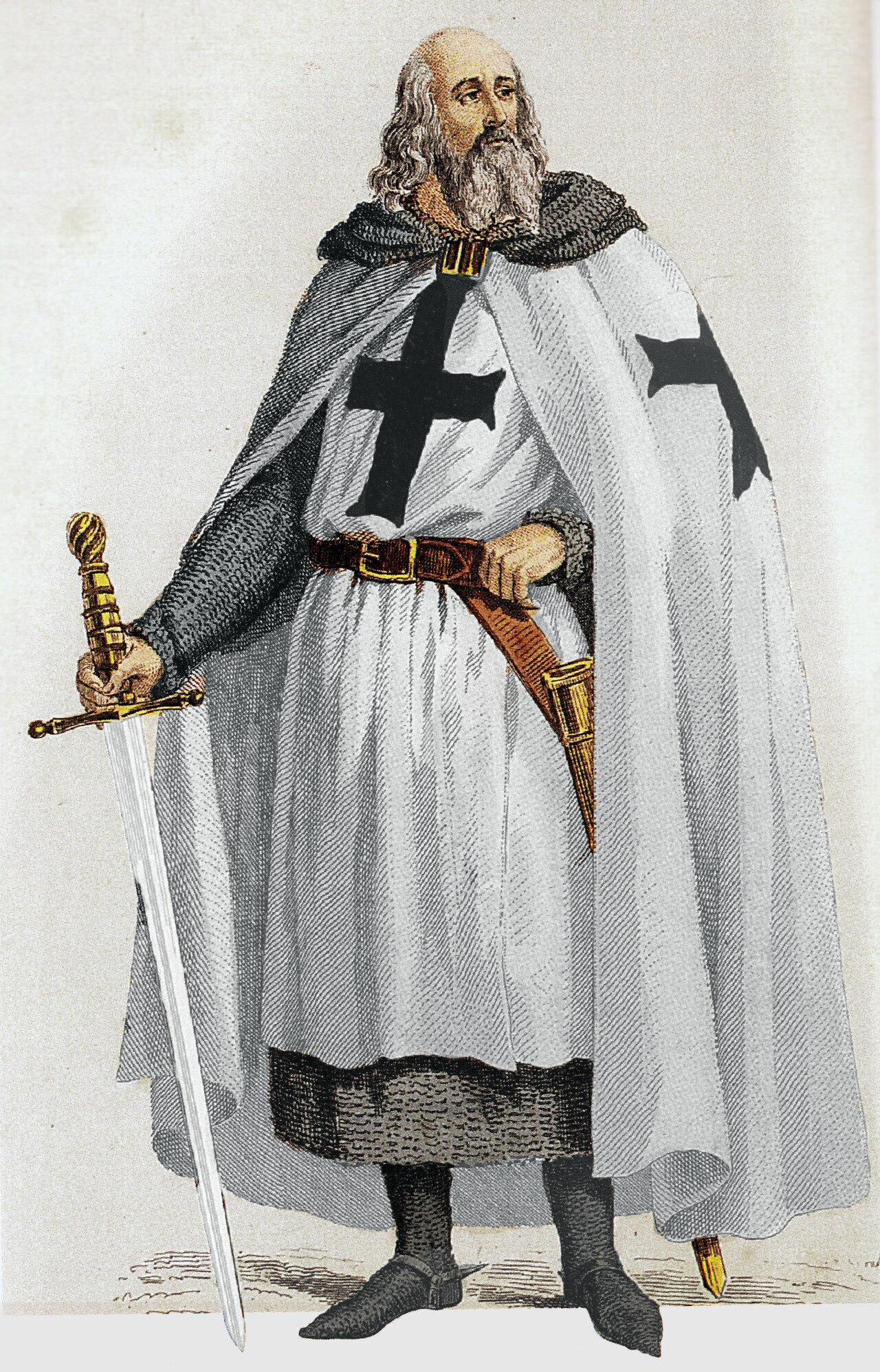
The Poor Fellow-Soldiers of Christ and of the Temple of Solomon were founded about 1119 by Hugues de Payens and a small band of knights, to protect pilgrims on the roads to Jerusalem after the First Crusade. They were quartered on the Temple Mount, in buildings identified with Solomon's Temple — which is where the name comes from.
They were formally endorsed at the Council of Troyes in 1129, and given a monastic Rule with the backing of Bernard of Clairvaux. In 1139 the papal bull Omne Datum Optimum exempted them from all authority but the Pope's.
What followed is one of the strangest institutional careers in European history. Sworn to individual poverty, the Order became collectively enormous — landholdings from Ireland to Palestine, and a financial network that let a pilgrim deposit funds in London and draw them in Acre. They are commonly, and not unreasonably, described as an early international bank.
Then the Crusader states collapsed. Acre fell in 1291, and the Templars lost the reason for their existence: there was no longer a Holy Land to defend, and they had no European kingdom of their own to retreat into.
The Destruction
On Friday, 13 October 1307, King Philip IV of France — deeply in debt to the Order — had every Templar in France arrested in a single coordinated dawn operation. The charges were heresy, blasphemy, and obscenity. Confessions were obtained under torture and widely retracted when torture stopped.
Pope Clement V, under heavy French pressure, suppressed the Order at the Council of Vienne with the bull Vox in excelso in March 1312. He did so, notably, without a finding of guilt — on the ground that the Order's reputation was damaged beyond usefulness.
On 18 March 1314, the last Grand Master, Jacques de Molay, having publicly retracted his confession, was burned on an island in the Seine.
And in 2001 a historian in the Vatican Secret Archives found a document that had been mis-catalogued for centuries. The Chinon Parchment, published in 2007, records that in August 1308 Clement V had heard de Molay and the other leaders, absolved them of heresy, and reconciled them to the Church — four years before he dissolved their Order and six before the French crown burned them. The Church's own record, lost for seven hundred years, says the charges did not stand.
Now the Hard Part
There is no documented connection between the medieval Order of the Temple and Freemasonry. None. Not a charter, not a lodge record, not a surviving line of succession.
The gap is roughly four hundred years. The Templars were suppressed in 1312. The earliest Masonic Templar degrees appear in the 1740s. In between there is silence — and the legends that fill it were composed in the eighteenth century, by people who tell us in their own writings that they were composing.
Serious Masonic scholarship has said this plainly for a very long time. Albert Mackey, the nineteenth century's great Masonic encyclopedist, dismissed the Templar-descent claim as having not a particle of historical evidence behind it. Modern research has not improved its position.
So Where Did It Come From?
Two men, and a good deal of eighteenth-century romance.
The Chevalier Andrew Michael Ramsay — a Scot living in Paris — delivered an oration in 1737 that recast Freemasonry's origins. Forget the stonecutters, he told the French: the Craft descends from crusading knights who bound themselves together in the Holy Land and carried the institution back to Europe.
Note carefully what Ramsay did and did not say. He pointed to the Knights Hospitaller of St. John, not the Templars. But he had supplied the essential idea — that Masonry was chivalric and crusading rather than operative and artisanal — and it landed on an aristocratic French audience that vastly preferred descent from knights to descent from bricklayers. Within a few years, degree-makers had supplied what the market wanted, and the Templars, being the more romantic and tragic order, displaced the Hospitallers in the story.
Baron Karl von Hund went much further. From the 1750s his German Rite of Strict Observance claimed outright that Freemasons were the secret successors of the Templars, preserved through an unbroken chain of hidden Grand Masters, and that Hund himself took orders from Unknown Superiors he was not at liberty to name.
He was asked to produce them for the rest of his life. He never did. The Rite spread across Germany, dominated continental Masonry for a generation, and then collapsed. At the Congress of Wilhelmsbad in 1782, the assembled brethren formally set aside the claim of Templar descent. The system did not survive its own founder by long.
Then Why Do We Keep It?
Because the American Commandery never depended on the pedigree.
The Orders conferred in a Commandery — the Red Cross, Malta, and the Temple — are allegorical in exactly the way the third degree is allegorical. No Mason believes he is a legal successor to Hiram Abiff either. The Order of the Temple takes the Templar story as a dramatic frame for a set of lessons about faith, constancy under injustice, and the defense of the defenseless. Those lessons do not require an unbroken charter, and they are not weakened by admitting there isn't one.
What the Commandery has done is real and measurable. The Knights Templar Eye Foundation, established in 1956, has given tens of millions of dollars to preserve and restore sight — funding pediatric ophthalmology research and surgery for children whose families cannot pay. The Knights Templar Educational Foundation has made student loans and grants for generations.
Grand Commandery of Colorado bodies work in Pueblo and across the state, and their charitable work runs on the same footing.
The Point
A Mason is asked to seek truth. Applied here, that means being willing to say four things at once:
- The medieval Templars were real, were probably innocent of the charges, and were destroyed by a king who owed them money.
- Freemasonry does not descend from them, and the claim that it does was manufactured in the eighteenth century by men we can name.
- Masonic Templary is nonetheless a genuine and serious body, working real allegory to real purpose.
- Its charities have restored sight to children, which is a better answer to “what have you got to do with the Templars?” than any pedigree.
The white mantle and the red cross are borrowed. What is done while wearing them is not.