
Harry Houdini was raised in a New York lodge that met in the daytime because its members worked at night. He spent the last years of his life doing something stranger than escaping handcuffs: hunting down the spirit mediums who were taking money from grieving people.
The Daylight Lodge
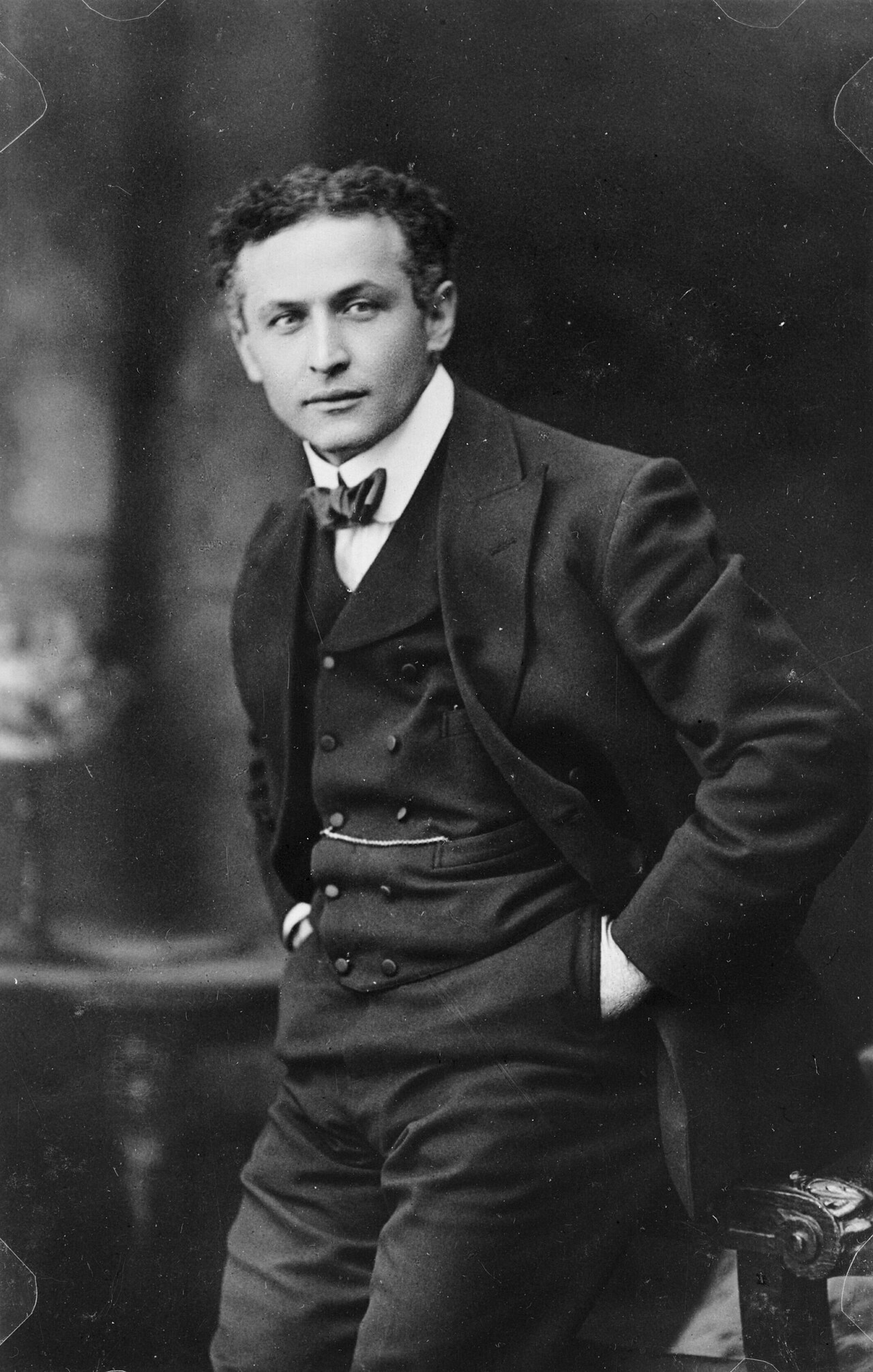
Houdini — born Erik Weisz in Budapest in 1874, the son of a rabbi — was raised a Master Mason on 21 August 1923 in St. Cecile Lodge No. 568, New York City. He was forty-nine and the most famous performer alive.
St. Cecile is a detail worth pausing on. Founded in 1865, it is a daylight lodge — it meets during the day rather than in the evening — because it was created for musicians, actors, stagehands, and newspapermen whose work made a seven-o'clock stated communication impossible.
That is the fraternity solving an ordinary problem in an ordinary way. A group of men could not attend at night, so a lodge was chartered that met when they could. Any lodge wondering today why its shift workers never come has the answer in a New York charter from 1865.
Houdini joined all four Scottish Rite bodies in New York in 1924 and was a member of Mecca Shrine Temple — the original 1872 temple. He was not a passive member: he gave a performance for the Scottish Rite Valley of New York before an audience of some four thousand in the Scottish Rite Cathedral, raising money for Masons in need.
What He Was Actually Doing at the End
The last chapter of Houdini's life is the one that matters, and it is not about escapes.
His mother, Cecilia, died in 1913, and he was devastated by it in a way friends described as never really lifting. Like a great many bereaved people in that decade — the decade of the Great War and the influenza pandemic, when a generation of families were burying their sons and had no bodies to bury — he went looking for a way to reach her.
Spiritualism was then an enormous business. Mediums held séances at high fees, produced ectoplasm and spirit writing and rapping tables, and delivered messages from the dead to people who desperately wanted them.
Houdini went to the séances. And because he was the greatest technical illusionist in the world, he saw exactly how every effect was produced — the reaching foot, the confederate, the concealed slate, the cold reading of a grieving stranger.
What he did next defined him. He turned professional debunker.
- He published A Magician Among the Spirits in 1924, methodically explaining the mechanics of the séance.
- He served on Scientific American's committee offering a cash prize for a demonstrable psychic phenomenon — and made sure the prize was never awarded, most famously in the drawn-out investigation of the Boston medium known as Margery.
- He infiltrated séances in disguise, with a policeman and a reporter, and exposed the operators publicly.
- In 1926 he testified before Congress in support of a bill against fortune-telling for money in the District of Columbia.
It cost him. He lost his friendship with Sir Arthur Conan Doyle — himself a Freemason, and a fervent believer in spiritualism who had lost his son in the war and became convinced Houdini possessed genuine supernatural powers he was dishonestly denying. The two men argued bitterly and never reconciled.
Why This Is Masonic Work
It would be easy to file Houdini under famous men who happened to join. That misses what he was doing.
Houdini never claimed his own act was supernatural. He was emphatic that everything he did was skill, preparation, and misdirection — a paid entertainment, honestly labelled. His objection to the mediums was not that they used trickery. It was that they used trickery on the bereaved, for money, while claiming it was real.
That distinction is exactly the third of the principal tenets. Truth, in the Masonic sense, is not the absence of art or ceremony — the Craft is full of both. It is the refusal to deceive someone about what is actually happening to them, particularly when they are vulnerable and you stand to profit.
A widow paying a medium to hear her husband's voice is the precise person the obligation exists to protect. Houdini spent the last three years of his life on it, at real cost to his reputation and his friendships, when he could have been selling out theatres instead.
Halloween, 1926
Houdini died in Detroit on 31 October 1926, of peritonitis following a ruptured appendix. He was fifty-two.
He had arranged a coded message with his wife, Bess, so that if any medium ever claimed to reach him, she would know whether to believe it. She held séances for ten years. The message never came, and she ended them.
There is a final irony he would have appreciated: the man who spent his last years disproving communication with the dead is now the subject of an annual Halloween séance, and the industry he fought is doing very well.
He left his professional library on magic and spiritualism — one of the great collections of its kind — to the Library of Congress, where it remains. That is the last act of a man who wanted the evidence preserved and public.