
The man who discovered penicillin was Master of a London lodge twice, held Grand Rank under the United Grand Lodge of England, and served as Senior Grand Deacon in 1942 — the year the drug he found began saving Allied soldiers by the thousand. He never patented it.
A Scottish Farm Boy in London
Alexander Fleming was born in 1881 on a farm in Ayrshire, the seventh of eight children. He came to London at thirteen, worked four years in a shipping office, and would probably have stayed there had a legacy from an uncle not paid his way into medical school. He entered St. Mary's Hospital Medical School in 1903 and stayed at St. Mary's, in one capacity or another, for the rest of his working life.
In the First World War he served in the Royal Army Medical Corps in France, working on wound infection in battlefield hospitals. What he saw there set the rest of his career: men surviving their wounds and then dying of sepsis, and antiseptics that killed the patient's own defenses faster than they killed the bacteria. He published on it, and was largely ignored.
The Masonic Career
Fleming was initiated in 1909, at twenty-seven, in Sancta Maria Lodge No. 2682 in London. He was then a junior researcher with no money and no reputation.
He did not drift. His record is that of a working lodge member across four decades:
- Joined London Scottish Rifles Lodge No. 2310 in 1911.
- Senior Warden of Sancta Maria in 1922; Worshipful Master in 1924.
- Joined Misericordia Lodge No. 3288 in 1925, and served as its Master in 1935.
- Awarded London Grand Rank in 1934.
- Appointed Senior Grand Deacon of the United Grand Lodge of England in 1942.
- Promoted Past Senior Grand Warden in 1948.
Set those dates against the science. He made the penicillin observation in 1928, was Master of a second lodge in 1935, was appointed Senior Grand Deacon in 1942 as penicillin went into mass production for the war, and received the Nobel Prize in 1945 — sharing it with Howard Florey and Ernst Chain, who did the work that turned his observation into a medicine.
The Petri Dish
The story is famous and usually told wrong, and the accurate version is better.
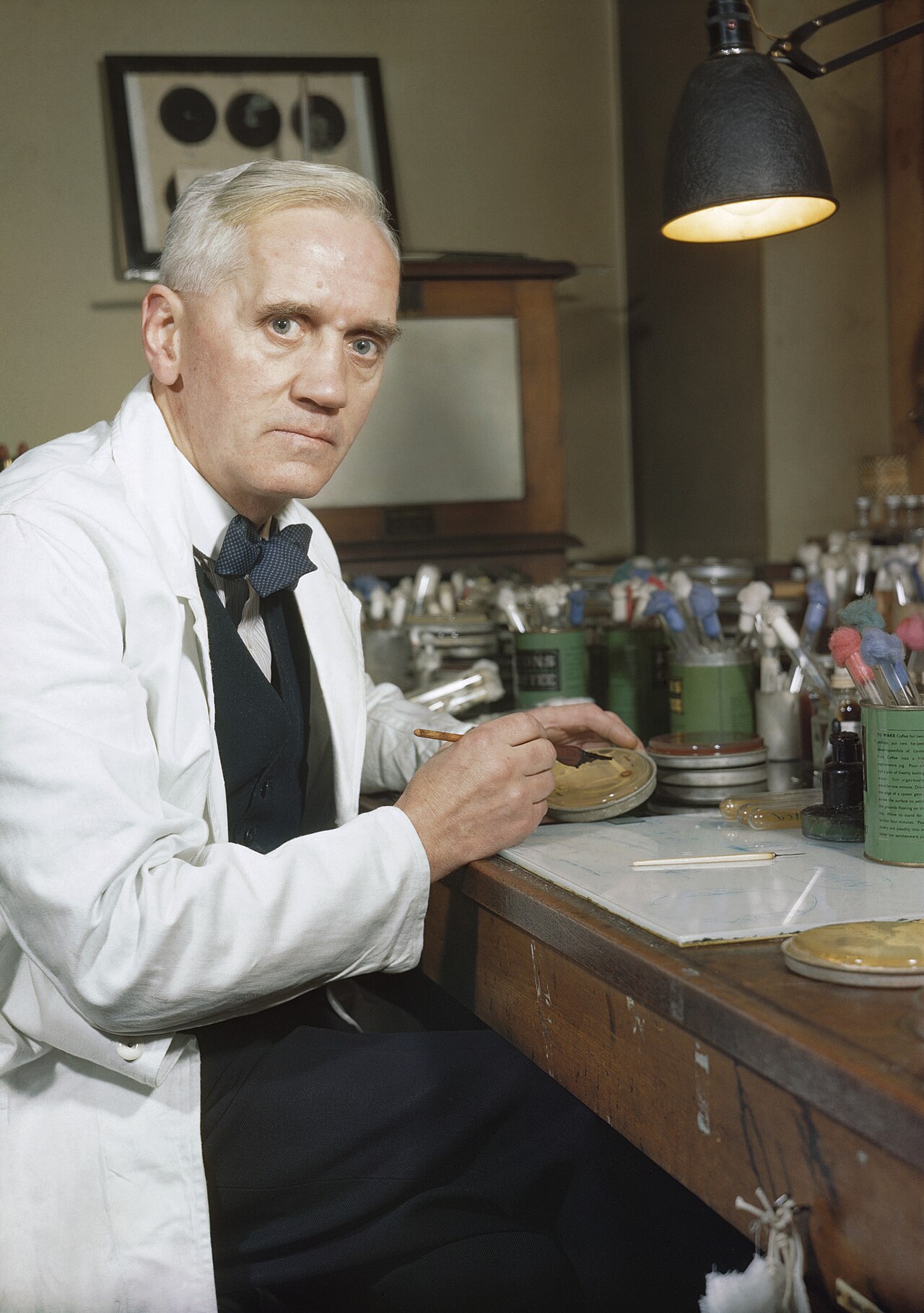
In September 1928, Fleming returned from a holiday to a laboratory bench he had left in his customary state of disorder. Among the culture plates was one of Staphylococcus that had been contaminated by a mould. Around the mould, the bacterial colonies had dissolved.
The luck was real: the spore, the weather, the untidy bench. What was not luck was the response. Plenty of bacteriologists had seen contaminated plates and thrown them out. Fleming looked at a ruined experiment and asked what had ruined it, isolated the mould, identified it as a Penicillium, established that the substance it produced killed bacteria without harming animal tissue, and published in 1929.
Then almost nothing happened for a decade. Fleming could not purify or stabilize the compound, and the paper attracted little attention. It took Florey and Chain at Oxford, from 1939, to solve the chemistry and prove it in patients, and American industrial fermentation to make it in quantity. By the Normandy landings there was enough penicillin for the Allied wounded.
Nobody knows the number of lives saved. It is measured in the hundreds of millions.
No Patent
Fleming did not patent penicillin, and neither did Florey or Chain.
The decision was deliberate, argued over, and made on the ground that a medicine of that consequence should not be anyone's property. It is worth remembering exactly how much money they declined, and that they declined it during and immediately after a war in which all three had every excuse to profit.
Fleming spent his remaining years warning about something else, and here he was ahead of nearly everyone. In his 1945 Nobel lecture he said plainly that it was easy to underdose a patient with penicillin, that exposing bacteria to non-lethal quantities would breed resistant strains, and that a man who used the drug carelessly would be morally responsible for the death of the person who eventually died of a resistant infection.
He said that in 1945. We are still failing to act on it.
Why the Craft Suits Him
It would be silly to claim Freemasonry had anything to do with penicillin. It did not.
What is worth noticing is the shape of the man. Fleming came from nothing, was made a Mason before he had accomplished anything, and kept working through the chairs of two lodges while doing the science. When the honors arrived — the Nobel, the knighthood, honorary degrees from most of the universities of Europe — he did not resign from lodge. He was appointed Senior Grand Deacon after the discovery and Past Senior Grand Warden after the Nobel, which means he was still turning up.
And the two central decisions of his public life are recognizably the ones a lodge tries to instill. He refused to make the medicine his property. And he told the world, at the moment of his greatest credit, the uncomfortable thing it did not want to hear about how his discovery would be misused.
Relief, and truth. He is buried in St. Paul's Cathedral.