Colorado Masons run a fund that does two things: it sends money to a brother's family in trouble, quietly, through his own lodge — and it puts Colorado high school seniors through Colorado colleges. It has been doing both since 1920.
The Colorado Masons Benevolent Fund
The Colorado Masons Benevolent Fund Association received its IRS ruling in 1920 and operates today out of 1370 Grant Street in Denver — the same Scottish Rite building where five hundred men voted RiteCare into existence on a snowy night in 1952.
It does two distinct jobs, and the difference between them is worth understanding.
Relief
The Fund makes assistance grants to Colorado Masons and their families in distress — and it makes them through the local lodge.
That routing is not bureaucratic clutter. It is the whole design.
A statewide fund in Denver has no way of knowing that a brother in Pueblo has been out of work for four months, or that a widow's furnace has failed in February, or that a family is one repair bill away from real trouble. His lodge knows. His lodge has the standing to ask, and the discretion to keep it private.
So the money is pooled at the state level, where scale makes it possible, and the judgment stays local, where the knowledge is. The brother deals with men he knows. He does not fill out an application to a foundation in Denver, and his neighbors never learn about it.
Anyone who has been on the receiving end of institutional charity understands why that matters. Relief that costs a man his dignity is only half a kindness.
Scholarships
The Fund's other program is larger and more public: scholarships for Colorado public high school seniors going on to college in Colorado. There is a parallel program for students entering vocational and technical training.
Three features of it deserve notice.
It is open to public high school seniors generally — a student does not need a Masonic relative. It requires the student to stay in Colorado, which is a deliberate bet on the state's own institutions and its own future workforce. And the vocational and technical track is funded alongside the academic one, which in a state that needs welders, linemen, machinists, and nurses is a good deal more useful than it is fashionable.
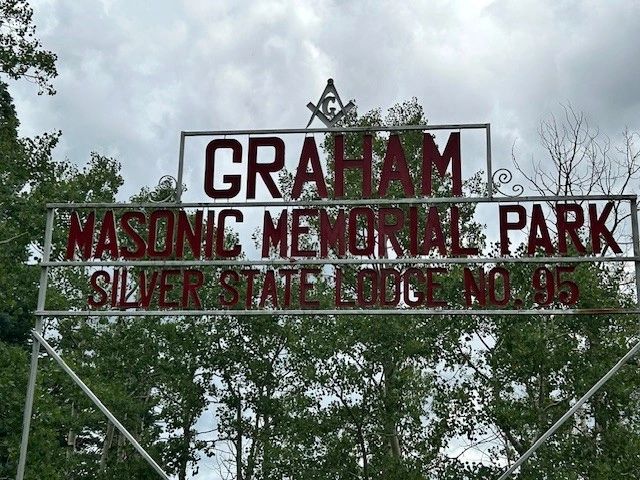
Graham Masonic Park
The other half of Colorado Masonic life is not a fund at all. It is a place.
Graham Masonic Park is where the brethren of Silver State No. 95 gather every fourth Saturday in June for the annual St. Johns Day Picnic — families, friends, visiting brethren, awards, and a long Colorado evening.
Standing there are the cornerstone and the great double-headed eagle from the Scottish Rite Temple at 15th and Elizabeth, relocated when the Lodge left that building. Silver State met in that temple from 1951 until 1999, sharing the great room with the Scottish Rite bodies for nearly half a century, before returning to the historic Masonic Temple at Broadway and Evans where it meets today.
So the picnic happens in the shadow of a building the Lodge no longer occupies — or rather, of the two pieces of it that were worth carrying away. A cornerstone, which is the stone everything else was measured from. And the eagle, which is simply the thing the brethren could not bear to leave.
Why a Picnic Is Not a Trivial Thing
It is easy to file the St. Johns Day picnic under social and move on. That would be a mistake, and this series has already laid out why.
The two St. Johns' days fall near the solstices, and they became the Craft's fixed points because a medieval stonemason could only get away at midsummer and midwinter. The annual assembly and the annual feast were held then. That is a genuinely operative inheritance — six centuries of masons pausing the work at the turn of the year to eat together.
And it is the one occasion that includes everybody. A tyled lodge, by definition, excludes the wives, the children, the friends, and the neighbors. Nearly everything a lodge does happens behind a door most of the people in a Mason's life will never go through.
The fourth Saturday in June is the answer to that. It is where a family gets to see what their father or husband has been giving his Thursday nights to for thirty years, and to meet the men he has been giving them to.
A lodge that never opens that door will not have a lodge in twenty years, whatever its balance sheet says.
The Two Halves
Between them, the Benevolent Fund and the park cover the full range of what a Grand Lodge jurisdiction can actually do.
One is money moved carefully — pooled statewide, distributed locally, and handed over in a way that does not humiliate the person receiving it. The other is a day in the open air that costs almost nothing and holds the whole thing together.
A hundred and thirty-odd years on, Silver State No. 95 is still doing both.