
On 5 August 1884 it poured with rain on Bedloe's Island, and the Grand Master of Masons in New York went ahead anyway — applying the square, the level, and the plumb to the cornerstone of the pedestal of the Statue of Liberty, and striking it three times with his gavel.
The Ceremony
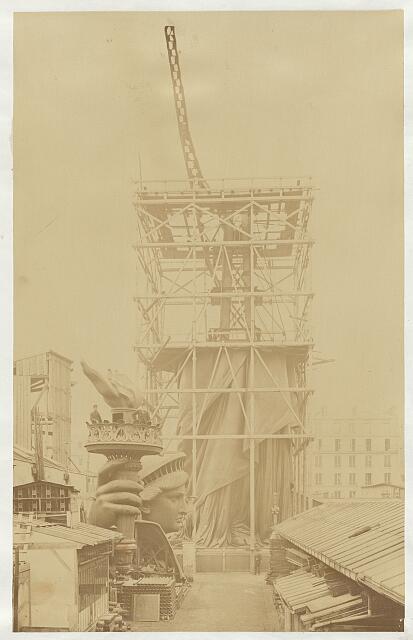
The pedestal was America's half of the bargain. France gave the statue; the United States had to build something to stand it on, and to pay for it. The fundraising was a grind, and the pedestal's cornerstone laying in the summer of 1884 was one of the milestones that kept the project alive in the public eye.
The Grand Lodge of New York was invited to lay it, which in 1884 was simply what one did.
On 5 August 1884, the steamer Bay Ridge — draped with the French tricolor and the Stars and Stripes — carried roughly a hundred members of the Grand Lodge of New York, visiting Grand Officers, and civic officials out to Bedloe's Island. Representatives of the United States and French governments were there, along with Army and Navy officers, foreign legations, and a crowd of citizens.
It rained torrentially. The ceremony proceeded on schedule.
William A. Brodie, Grand Master of Masons in the State of New York, tested the stone and found it square, level, and plumb. He applied the mortar with the trowel, the stone was lowered into place, and he struck it three times and declared it duly laid. The elements — corn, wine, and oil — were poured.
A copper box was placed within the stone, holding a copy of the Constitution, newspapers of the day, coins, and other records of the moment.
Bartholdi
Frédéric Auguste Bartholdi, the sculptor, was himself a Freemason — a member of Lodge Alsace-Lorraine in Paris, a lodge of writers, intellectuals, and public men.
The lodge's name carries its own weight. Bartholdi was an Alsatian, from Colmar, and Alsace and Lorraine had been taken by Germany after France's defeat in 1870–71. A lodge of Parisians naming itself for the lost provinces was making a statement, and a sculptor from Colmar joining it was making a personal one.
Bartholdi reported to his brethren on the statue's construction, and in 1887, after the dedication, came back and told them about the welcome he had received in New York and the enthusiasm his work had raised.
The statue was dedicated on 28 October 1886, in the rain again, by President Grover Cleveland.
What This Does and Does Not Mean
Since this is a favorite of the conspiracy literature, the boundaries are worth drawing precisely.
What is true: the pedestal's cornerstone was laid in a Masonic ceremony by the Grand Lodge of New York, on a date and in a manner fully documented in the Grand Lodge's own proceedings and in the newspapers. The sculptor was a Freemason. None of this was secret; it was covered in the press.
What is not true: that the statue is a coded Masonic idol, a disguised pagan goddess, or a monument to a secret order. The figure is Libertas, the Roman personification of liberty, in a tradition of allegorical statuary that runs continuously through European art. The torch is enlightenment, the tablet bears the date of American independence, and the broken chain at her feet — which most visitors never see — means what it obviously means.
Bartholdi explained his intentions repeatedly, in writing, at length. The design was debated publicly for two decades. There is no missing layer.
The cornerstone ceremony is not evidence of a hidden hand. It is evidence of something much more ordinary and, to a Mason, more interesting: that in 1884, when the United States wanted to begin an important public work with dignity, it asked the Grand Lodge to come and do it — the same as it had for the Capitol in 1793, and the same as Colorado's Grand Lodge did for courthouses and schools across this state.
Why It Fits the Craft Anyway
There is a genuine kinship here, and it has nothing to do with secrets.
A cornerstone is tested with the square, the level, and the plumb because everything raised on it inherits its errors. It is consecrated with corn, wine, and oil — nourishment, refreshment, joy — as a wish for what the building will provide to the people who use it.
Consider what was raised on that particular stone. Between roughly 1892 and 1954, some twelve million immigrants entered the United States through Ellis Island, in the shadow of that statue. Many of them arrived with nothing, spoke no English, and were fleeing something. The first American thing they saw was a woman holding up a light.
Nourishment, refreshment, and joy is not a bad summary of what they were hoping for.
Pueblo was built by exactly those people — Welsh ironmasters, Italian and Slovak mill hands, and families from Mexico who came north to the smelters and the rail yards. A good many of them, or their parents, came past that stone.
The men who laid it stood in the pouring rain in August 1884 and tested it square, level, and plumb. It held.