Freemasonry is a fraternity of men, and always has been. That fact created a problem the Craft has been working on for a hundred and seventy years, and the most durable answer to it was written by a Kentucky schoolteacher confined to bed with an injured leg.
The Problem Rob Morris Set Out to Solve
Robert “Rob” Morris (1818–1888) was a teacher, a lawyer, a prolific writer, and one of the most energetic Masons of the American nineteenth century. He served as Grand Master of Kentucky in 1858–59, travelled to the Holy Land in 1868 to study the sites named in the ritual, and wrote so much Masonic verse that in 1884 the fraternity crowned him Poet Laureate of Freemasonry — a title held by exactly one man.
The problem he kept circling was this. A Master Mason's obligation extends to the widows and orphans of Masons. His lodge sends relief to a brother's family. And yet the wives, mothers, sisters, and daughters on whom that obligation fell had no standing of their own, no means of identifying themselves as entitled to it, and no part in the institution their men gave their evenings to.
Morris's answer was not to admit women to the lodge — he never proposed that — but to build an adoptive rite: a related, self-governing order with its own ritual, open to Master Masons and to the women of their families together.
Five Women and a Five-Pointed Star
In 1850, laid up with an injured leg and with time to write, Morris drafted the ritual of what became the Order of the Eastern Star.
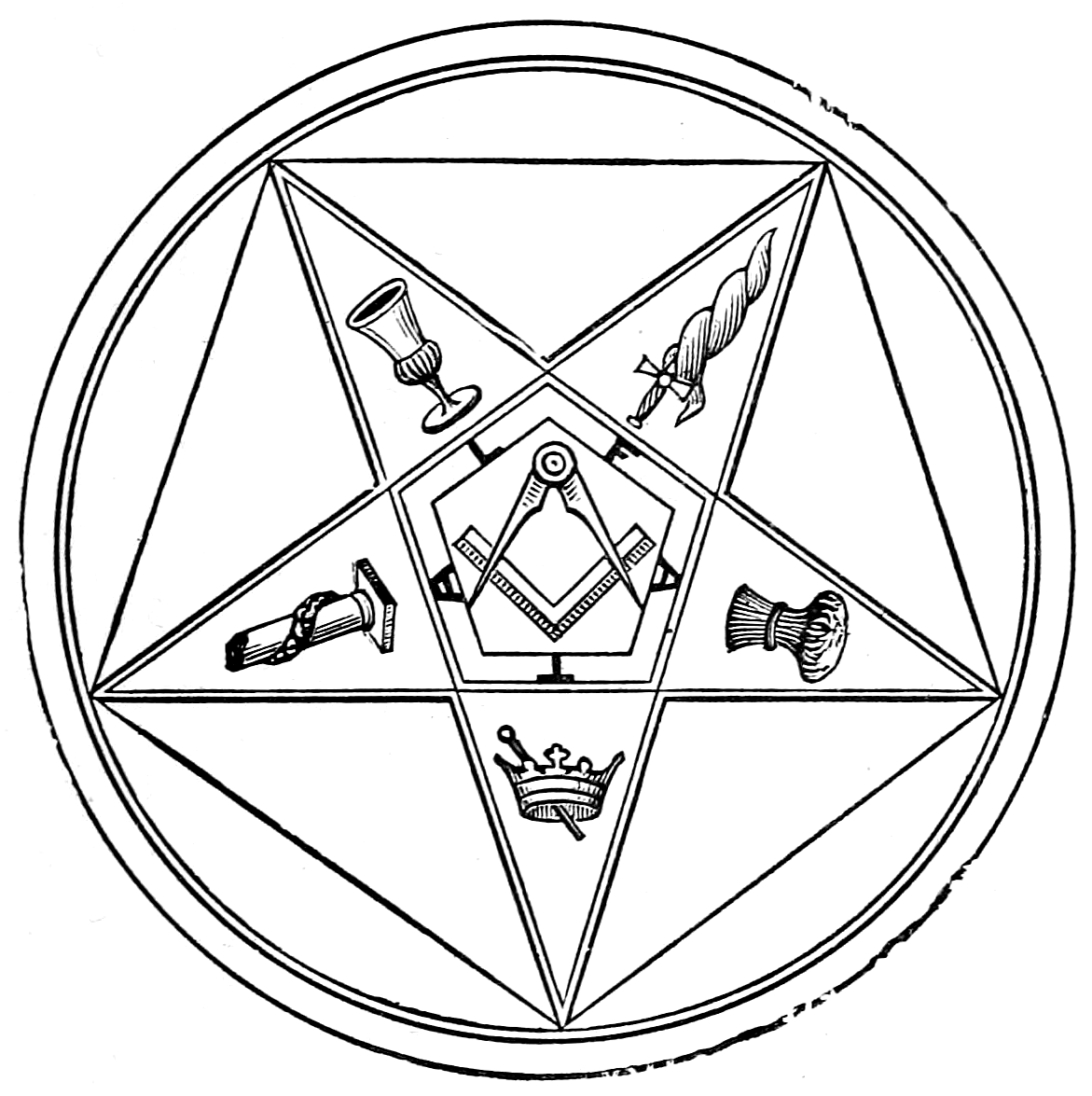
Its structure is one of the more elegant pieces of design in American fraternalism. Each point of the star is a woman from Scripture, and each stands for a specific virtue demonstrated under a specific kind of pressure:
- Adah, Jephthah's daughter — fidelity to a vow, at the highest imaginable cost.
- Ruth, the Moabite widow gleaning in Boaz's field — constancy and loyalty to family not her own by blood.
- Esther, queen of Persia — courage before power, on behalf of her people.
- Martha, sister of Lazarus — faith held onto in grief.
- Electa, the elect lady of the Second Epistle of John — charity, and endurance of persecution.
Note what these five have in common. Not one of them is a passive figure. Each is a woman who has to decide something difficult and then act on it alone. For a ritual written in 1850, that is a more serious view of women's moral agency than the period is usually credited with.
Macoy Makes It Work
Morris was an originator, not an administrator, and by his own account the Order did not thrive under his management. In 1866 he handed it over to Robert Macoy of New York — a Masonic publisher with a real gift for organization.
Macoy reworked the ritual and published the Adoptive Rite Ritual in 1868, and, more importantly, reorganized the Order around chapters with elected officers rather than the looser family-based degree conferral Morris had envisioned. That change made it an institution instead of a ceremony.
It worked. Chapters spread rapidly, state Grand Chapters followed, and on 6 November 1876 the General Grand Chapter was organized at Indianapolis. The Order of the Eastern Star has operated under that structure ever since.
What It Actually Is
A few points of fact, because they are commonly muddled:
The Eastern Star is not a women's Masonic lodge. It does not confer Masonic degrees and does not make Masons. It is a separate order with its own ritual and its own government.
Both men and women belong. Master Masons in good standing are eligible, alongside their female relatives. Offices are shared: a chapter is presided over by a Worthy Matron, with a Worthy Patron — who must be a Master Mason — at her side. The Worthy Matron presides. That was a genuinely unusual arrangement in 1876, and it is the reason the Order is often described as the largest fraternal organization in the world admitting both men and women.
Eligibility has broadened over time. It began with wives, widows, mothers, sisters, and daughters of Master Masons; the categories have since widened in most jurisdictions to include granddaughters, stepdaughters, nieces, half-sisters, and others.
There is a parallel Prince Hall Order of the Eastern Star, with its own Grand Chapters and its own long history.
The Work
The Eastern Star's charitable record is substantial and unglamorous, which is generally the sign that it is real.
Chapters and Grand Chapters fund scholarships in enormous numbers — for nursing students, for seminarians, for music students. They operate and support Eastern Star homes for the elderly across the country. They give to cancer research, to heart and lung projects, to service dog programs, to disaster relief. Most of it happens locally, in amounts small enough that no one writes it up, from chapters of a few dozen members who have been quietly doing it for decades.
Membership has declined along with every other American fraternal body since the mid-twentieth century. The chapters that remain tend to be the ones that kept doing the work.
The Star in Pueblo
The Eastern Star has been part of Masonic life in Colorado for well over a century, and Pueblo chapters have shared the Broadway and Evans temple and the wider Masonic community for generations. For the family of a Silver State brother, it is the most direct answer to the question that follows most first conversations about the Craft: and what about the rest of us?
Rob Morris asked that question in 1850 and spent a year in bed answering it. The answer has outlived him by nearly a century and a half.